

The Scandinavians mainly use navigation, without this excluding their ease of movement by land, as we will see on other maps.
In 772, Charlemagne had undertaken cruel wars against the Saxon pagans. The fighting was fierce, but in 804, the Saxons submitted. The Saxons had been able to resist for so long thanks to the support of their northern neighbors, the Danes. The Saxon case being closed, Charlemagne undertook to go on the offensive against the Danes.
In 804, he seized Réric, the port that provided regular income to the King of the Danes. After this coup de maitre, Charlemagne knew that he had won. Either the king of the Danes tries to retake Réric and the Frankish armies will crush the Danish army; or he gives up taking back the port, he will end ruined and lose his throne. In either case, Charlemagne won.
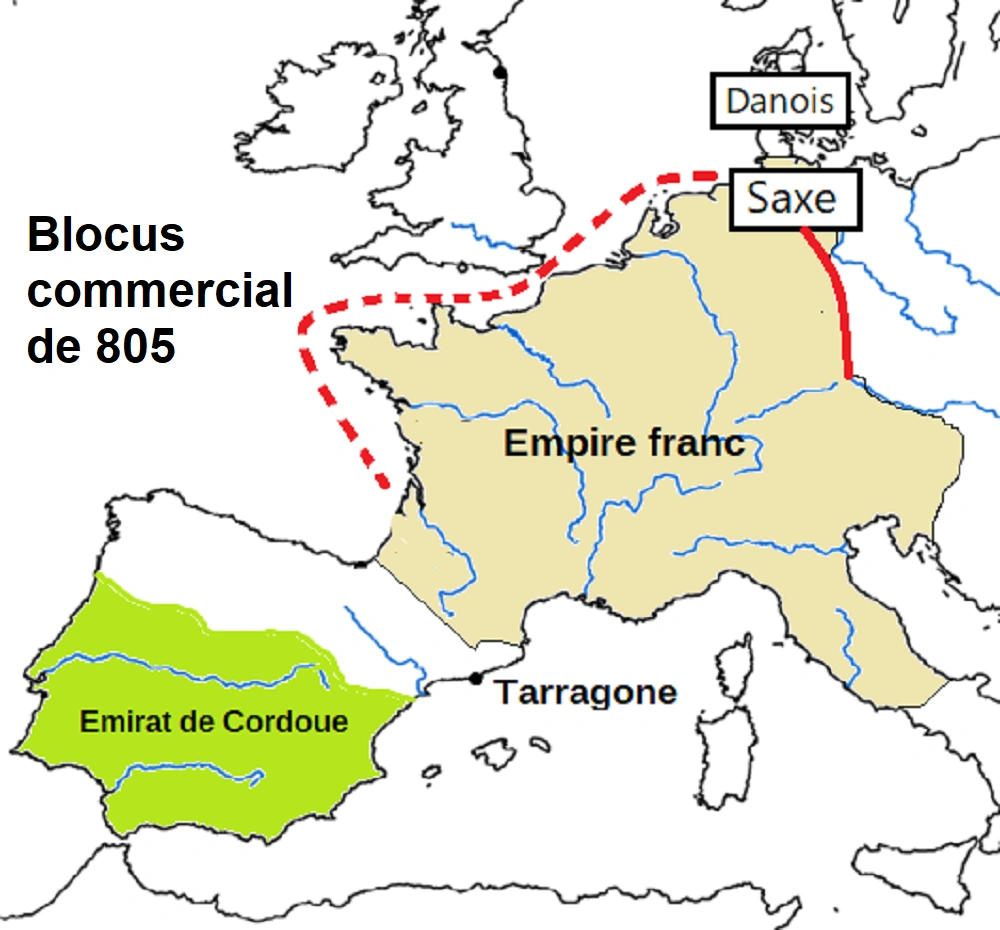
The following year, the emperor ordered a trade blockade aimed at asphyxiating the northern economy. "The capitulary of Thionville (805), tells us Robert Latouche, which is an instruction intended for missi, contains a series of prescriptions concerning merchants who go to these regions. The author prohibits them from selling weapons and brooms, that is to say, military clothing. He then establishes a kind of customs border that he forbids them to cross. This line, which ran from the mouth of the Elbe in the north to end up in the south at the Danube, was marked out by posts guarded by men of trust " (Latouche, 199). This capitulary aims to create an impassable customs barrier in order to strike the men of the North in what they have most precious: their commercial income. Indeed, in the Scandinavian world, sovereigns did not levy taxes on agricultural production; they derived their income from trade. A king controlling a port, took berthing rights, storage rights, but also recovered revenue from freight because he often owned a commercial fleet carrying the goods of traders who did not own ships.
The capture of Réric in 804 and the capitular of Thionville in 805 were a declaration of trade war. The Danes had to react. They did it in 808 by destroying Réric and transferring traders and goods to a new port, out of reach of Charlemagne: Hedeby.
From now on, if the Scandinavians want to acquire goods from the south without going under the Frankish caudine forks, they have no choice but to bypass the empire. The Swedes will do it from the east in the 860s; the Danes seem to have done it from the west a century earlier.