

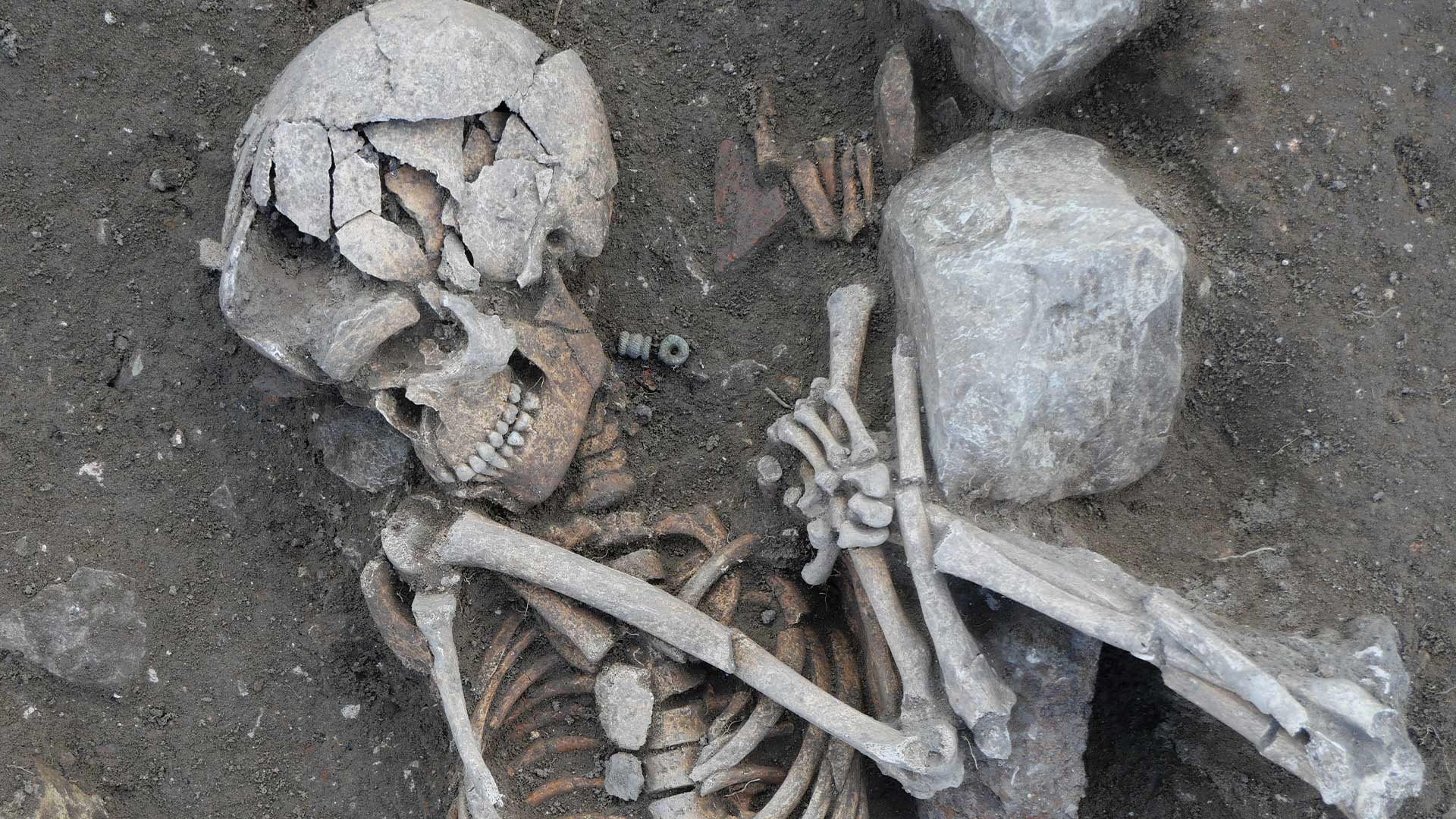
In 2024, during a real estate operation at the Flotte en Ré, developers stumbled upon a medieval cemetery. The excavation led by Annie Bolle, an archaeologist from INRAP, was conducted between October 3 and December 20, 2024, and uncovered nearly fifty tombs, five of which were very surprising.
At that time, Christians were buried naked, lying on their backs, without any objects. However, five tombs did not correspond to this ritual. The INRAP report states: Three individuals are in an unusual position: one is lying on the left side with his lower limbs flexed, the other is lying on his stomach, and the third is on his back but his limbs are folded and raised. For the last two, it remains to be confirmed whether these positions are voluntary or related to the collapse of the tomb architecture. In any case, these two burials are out of the norm since they are oriented with the head to the south-southwest." These tombs were accompanied by furniture: "These burials include furniture (adornments, clothes or personal items) and called "dressed"; they are quite exceptional in the Carolingian period. The furniture includes two combs (made of bone or antler), one with a geometric decoration that finds parallels in the Frisian region. Amber, glass, bone and copper alloy beads are present in two burials, as a necklace or accompanying metal objects. These pearls are similar to well-known examples throughout the Nordic world where they are dated to the 9th century. The metal furniture includes several iron objects including a pivoting knife, a model already identified in the south-east half of England. Finally, a copper alloy belt (and perhaps silver plating?) features a décor of interlacing and evokes the Anglo-Saxon world."
Of course, caution is required. But the idea that it could be Vikings is in everyone’s minds. The Fleet is also a Scandinavian name: the Romans and the Franks spoke of classis and not fleets, flotti is a Scandinavian word. But the Viking possibility remains to be validated and archaeologists are cautious. These individuals could also be traders, Frisians, Saxons or Anglo-Saxons.
To clarify matters, DNA samples were taken and sent to a reputable American laboratory. We just have to wait for the results.
If the results do not find any trace of Nordic origin, the mystery will thicken.
On the other hand, if DNA reveals individuals of Nordic origin, it will only mean that Scandinavians were settled and died on the island of Ré where they lived among the Christians. They could then be traders.
Joël Supéry