Since ancient times, the Mediterranean has been at the heart of world history. Egyptians, Phoenicians, Greeks, Carthaginians, Romans and Arabs will, in turn, lead the history of the world. But in the Middle Ages, there was a shift of the world towards the shores of the Atlantic where new powers – Portugal, Spain, France, England, the United Provinces – took control of the destiny of the world.
This shift did not go through Spain, Normandy or Brittany; it went through Aquitaine, that of Eleanor.
In the 12th century , Eleanor’s Aquitaine rose to the forefront of European political powers. It is less well known that it will also become the West’s largest maritime power.
Aliénor had the roles of Oléron written, which became the heart of international maritime law. The stern rudder, which revolutionizes the art of shipbuilding, is also known as a "Bayonnaise" rudder. La cogue, the boat that made the fortune of the Hanse, would have been developed in Bayonne. It was the Basque and Gascon whale hunters who introduced the Dutch and the English to polar navigation; it was the Templars of La Rochelle, Bayonne, and Capbreton who, fleeing France in 1307, will find refuge in Portugal where they will introduce their guests to the art of shipbuilding and navigation. A know-how enabling them, a century later, to embark on the discovery of the world. Finally, it is the Aquitanians who will teach the English about the sea.
This last point may be puzzling, but it is very simple to understand.
When William the Conqueror invaded England in 1066, he brought stones from the quarries of Caen to build the Tower of London, Westminster Abbey and Canterbury Cathedral. By these constructions, he intends to signify to the English that from now on they are dependent on Normandy. The corollary of this symbolic measure will be very practical: as the Romans had done before him, William will require that only ships from Normandy supply England. He arrogates to himself the monopoly of maritime transport. From 1066, no more transport ships were built in England; British shipyards only built river barges and small fishing boats.
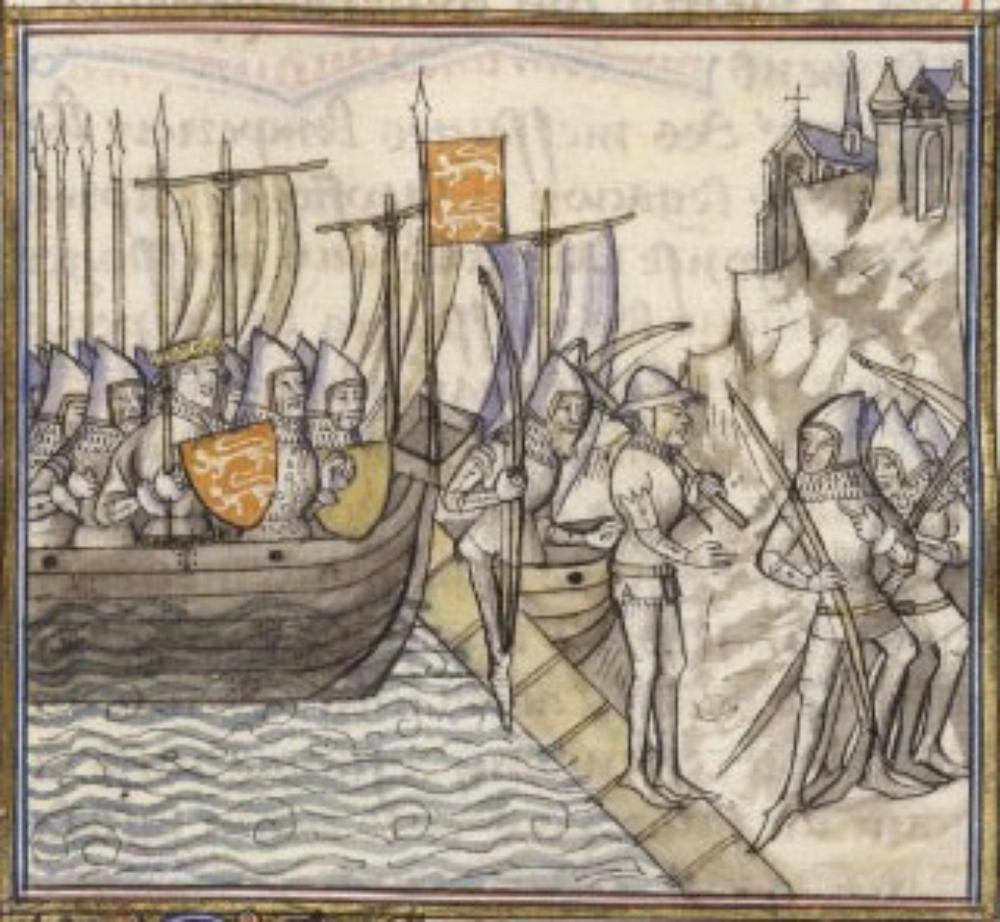
When, eighty-eight years later, Henry II Plantagenet became King of England, the English no longer knew how to build boats. For his navy, the new king of England can only count on his shipyards in Normandy and those in Aquitaine. When Philip Augustus seized Normandy in 1204, Aquitaine remained the only supplier of ships and sailors to England. It was not the English who taught the Aquitanians their maritime and naval know-how; the opposite happened.
For several centuries, the kings of France, England and Castile built their most beautiful boats in Bayonne. In 1411, the fleet of Henry IV of England included a Bayonnais ship 186 feet long (57m) and 46 (14m) wide, larger than the "Royal Sun" which was 165 feet long and 45 feet wide, a boat launched... two and a half centuries later, in 1669.
The Gascons and Basques, known to have visited the Banks of Newfoundland before the discovery of America, were the greatest sailors of that time. Yet no one knows where their exceptional know-how comes from or why Gascony has one day revealed itself as the greatest maritime power in the West.
Yet there is an explanation for this maritime genius. It would not be innate; it would be a legacy. We must look for it in the heritage of history.
Joël Supéry