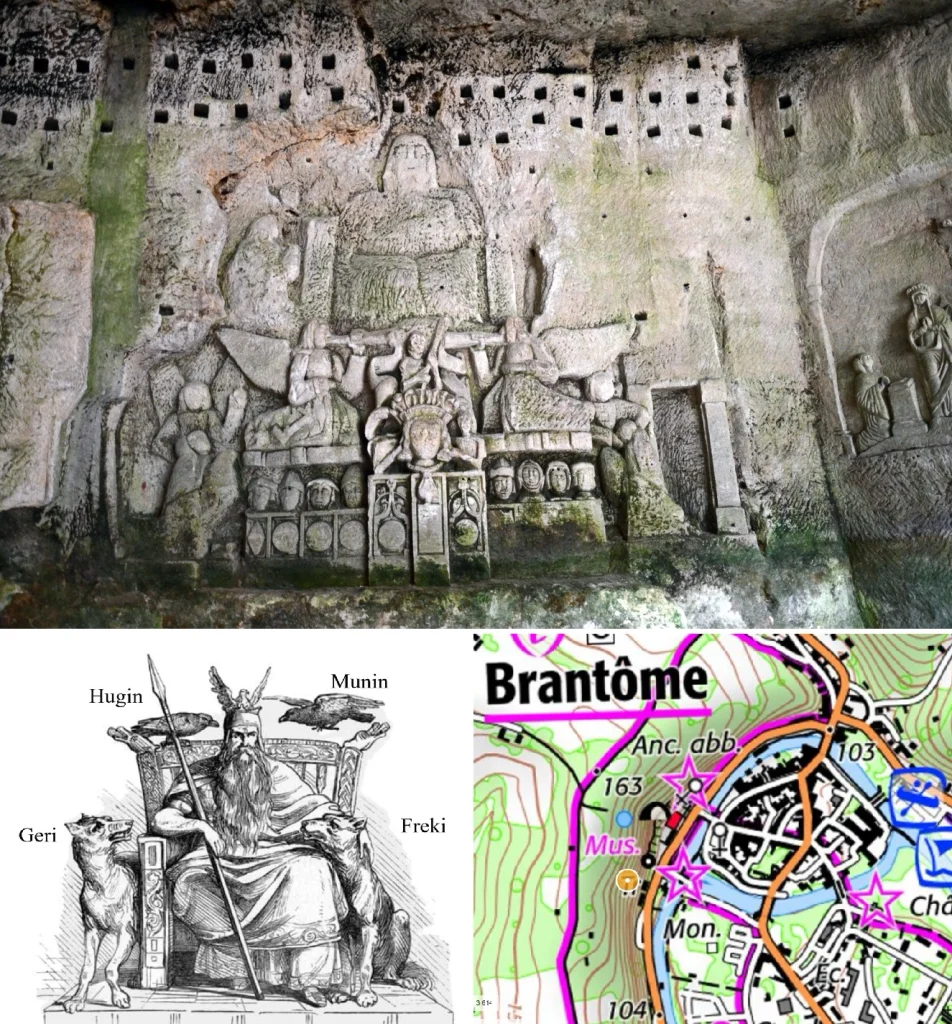
The abbey of Brantôme (24) hides in its midst the cave known as the Last Judgment. Many bas-reliefs surround a character on his throne. Archaeologists and art historians are unanimous: it is a pagan deity. Which pagans? We don’t know. However, a Fragment of the Bishops of Périgueux, 21 km away, tells us that around 970, the bishop built no less than five castles around the city of Périgord to defend against the "pagans". The pagans in question were Normans. Question: could this pagan god of Brantôme belong to the Nordic pantheon? Only one god is represented on his throne. Odin. He is surrounded by his two wolves, Geri and Freki, and his two ravens, Hugin and Munin, who rest on the back of his throne after having toured the nine worlds to inform their master of what is going on there. Now, in Brantôme, we can make out two silhouettes on either side of the throne; one seems to represent a kneeling disciple, the other has been erased. It is likely that the Christian sculptors reworked the two wolves to make them disappear from the scene. As for Hugin and Munin, we do not see them. On the other hand, above the God, we see niches dug into the stone. The tourist brochure tells us that these are pigeon lofts... In reality, they are nesting boxes for jackdaws. The jackdaw is a Corvid who loves the caves where he lives in colony. These nest boxes embody Hugin and Munin. This bas-relief clearly represents Odin. It had to be sculpted during the pagan rule between 840 and 980. After the Christian victory, an abbey will be founded on the pagan place of worship, a usual way to eradicate a religion. As for Brantôme, this name could come from the Norse brand-holm, the burnt islet. Brantôme sur finds itself on an island whose south channel has probably been dug to isolate a camp nearly 300 meters in diameter.